Showing posts with label Honda Indy. Show all posts

Wednesday, July 20, 2016

Behind the scenes at the Toronto Honda Indy 2016


THE HONDA INDY TOOK OVER THE EXHIBITION GROUNDS and Lakeshore Road again last weekend, with a full card of support races that included the return of NASCAR to Toronto after five years. Australia’s Will Power was the winner at the end of the weekend, while last year’s winner, Josef Newgarden, crashed on lap 58, right in front of where I was taking pictures.

It only looks like a race weekend like the Honda Indy is about the cars, but there are hundreds of people working flat out behind the wheel, in the paddocks and in the pits. I talked to eight of them, asking them about everything from the changes made to the track this year to how women are making their way into motorsport to the future of racing beyond the internal combustion engine and why NASCAR isn’t bigger in Canada.


Markham-born Daniel Morad was the only driver who competed in two different series during the Honda Indy weekend, racing in the Ultra 94 Porsche GT3 Cup series and accepting a last minute invitation to fill a seat in the NASCAR Pinty’s Series. Morad finished seventh in the NASCAR stock car and came first in the Porsche on Saturday and second on Sunday.

The team owner gave me a ring on Friday morning - I was still in bed at that point - and he said go get your medical forms taken care of from NASCAR. Luckily I have a doctor who can take care of that really quickly. I probably set record time going to the doctor's offices and back to make it in the car in time."

"I literally went from the doctor's office to my race seat and practice, my first time ever in a NASCAR. I'm really excited to race in this series - rubbin's racing they say, and you're allowed to do it, whereas in the Porsche you're supposed to keep it nice and pristine. It's beautiful German engineering and the car is fantastic to drive. Two contrasting types of cars - one's trying to murder you out there and the other drives like a dream."


Jean-Francois Dumoulin (left) and his brother Louis-Philippe Dumoulin (right) are from Trois-Rivieres, Quebec and compete against each other in the NASCAR Pinty’s Series. They talked about the changes to the Toronto track and what’s needed to make NASCAR bigger in Canada. Louis-Philippe finished fourth and Jean-Francois finished tenth at the end of Saturday’s race.

L.P. Dumoulin: “It's a great circuit - fast corners, slow corners, you're right between walls. We're used to it because we're from another street circuit, so it's a great place. They did some changes this year. I really liked the older configuration. This one is alright - we'll so how it goes during the race. Visually there's a lot of distractions - lights and posts and fences and you really have to pick your reference points quickly."

J.F. Dumoulin: “I think the social media is a big thing now. NASCAR needs to be stronger on that and on live TV. Because we have TV but it's hard to see it because it's a week after - when it's happening people are more willing to watch it."


Sara Price was the first woman to drive in the Stadium Super Trucks series, a big fan favorite in Toronto since it first raced here in 2013. Price, a 23-year-old motocross racer from California, led for the first three laps of Sunday’s race and ended up finishing ninth when her brakes began to fail.

I think in today's society a lot of women are coming up and a lot of girls are getting empowered and having their own voice. Obviously it takes a strong, independent girl to stick around the guys, and a lot of guys are looking at the women and giving them a lot of respect because they're looking at them as just another racer in another colour, not just a female. I think that's awesome and a lot of women should get into it because when you're in it it's amazing."


Scarborough-raised Neil Campbell is a mechanic working for Andretti Motorsports, with 25 years of experience in the business. He’s part of Marco Andretti’s Indycar crew; Andretti finished tenth.

“Those Formula E electric cars, they're going to be the future. In ten years you're going to see everything in that formula, and you can see how amazing that racing is, and I think we're heading that way. Especially with Andretti being part of Formula E in the next few years you're going to see the Indycars going that way as well, it just depends on the costs - one the costs go down in our development with Formula E, when we get a hang on that, we'll start doing that on IndyCar as well."


Alexander Rossi is in his rookie season in Indycar, but he’s a veteran of several international racing series, including Formula 1, where he’s still a reserve driver for Manor Racing. He was the winner of this year’s Indianapolis 500 after starting eleventh, the first rookie to win the race since 2001.

“I think initially there was a lot of shock related to it, because I couldn't fully process it. And then as the weeks went on it was very difficult to come to the realization that you've won because we had Detroit after that and Texas right after that. So it took about a month for it to settle in, and it was a very special thing for me to be an American who was able to win the 100th running and to be able to do it for Honda. After what was such a difficult year last year, it was such a tremendous privilege and honour."


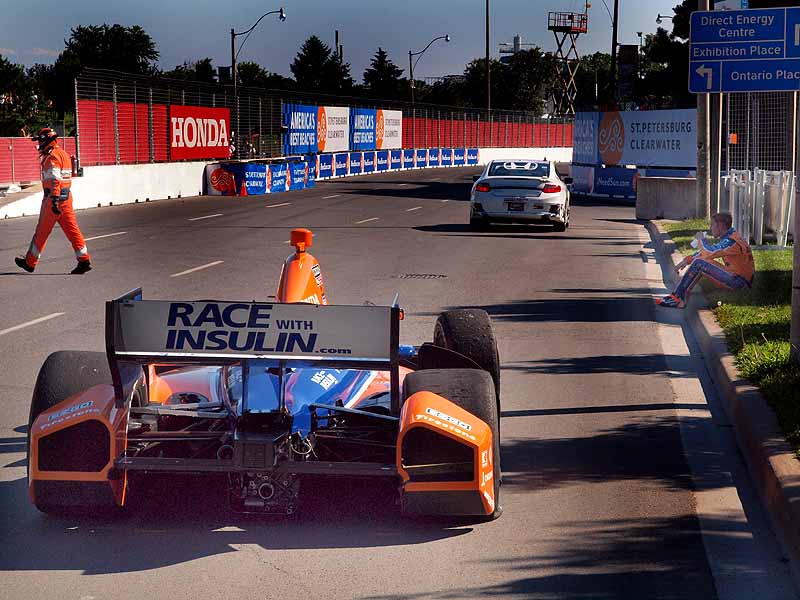
Kate Gundlach is an assistant race engineer for Chip Ganassi Racing, where she works on the timing stand in pit lane on driver Charlie Kimball’s team. She grew up around her father’s vintage motorcycle racing team and has a mechanical engineering degree from the University of Pennsylvania.

Toronto is extremely difficult, considering it's a street circuit and there's a lot that's not under our control - there are bumps, pavement changes, weather, pedestrian traffic that makes it unpredictable. It's hard to manage, and when you watch these cars go around the track in videos there's at least one tire off the ground at all times. It's tough for them to be within half a second of each other across the whole field - it's pretty impressive.”


Simon Pagenaud was the points leader going into the Honda Indy weekend in Toronto, and despite only finishing ninth, he retained his lead of 47 points over Will Power. He raced at Le Mans before joining Indycar in 2011 and is known for his obsession with the technical side of racing.

“The car is good. We're going to make some slight adjustments. It's been a good weekend. We have a new layout here that I enjoy, personally. People always complain about changes I guess, but I'm the opposite way. I like changes, I think it makes it more challenging, and it shows the driver's skills more to the fans. When the fans come to the racetrack they want to see a car sliding, they want to see a narrow track, they want to see action, and I think we're providing that with this new layout and I'm excited about it."


Tuesday, July 16, 2013

Toronto Indy 2013: Day 3, Race 2


It was Sunday morning and I needed to get to mass, but as I was covering the Indy races all weekend, it looked like there wouldn't be time. Luckily, I'd noticed signs all over the media centre advertising morning chapel and a Catholic service courtesy the Indycar Ministry, to be held in the drivers' centre in the BMO Field building on the other end of the track.

A couple of days previous I was in the area, just by turn 5, so I decided to check out the building. I was stopped by a security guard and told that my media pass wouldn't get me in. I told her about the signs, and wondered why they'd advertise mass to the media if we couldn't attend. Back at the media centre, I told the head of the press room about it, and he insisted that I was OK to get into mass - why else would the signs be up here? He said he'd talk to someone about it.

So of course on Sunday morning I arrived at the security desk at the driver's centre to be told by the same security guard that she hadn't heard a thing, and that I couldn't go to mass with a media pass. I insisted that this had all been straightened out, and that all she needed to do was talk to her bosses. Radios were picked up and phones dialed and a few minutes later I was told that, yes, I was clear to go in and attend mass, which turned out to be celebrated by an Oratorian up from Indiana.

I suppose I could have been angry about the levels of dysfunctional bureaucracy clearly at work (or not at work) here, but what struck me was how unique my queries about getting to mass seemed to be, which leads me to believe that I might have been the first member of the godless media to ask about going to Indy mass in a long time. Take from that what you will.


During mass, the priest asked us to pray for Ryan Briscoe, whose injury the day before had taken him out of today's race. Back at the press centre I learned that Carlos Munoz, a promising young driver currently leading the points in Indy Lights, had been asked by Panther Racing to take Briscoe's place in their National Guard car. There was a press conference with Munoz just after lunch, where he revealed that he'd gotten the call at 7pm the night before, and that his flight out of Toronto had been booked for 6am the next day.

"I didn't sleep much," Munoz told us. "I went at 8 o'clock to try the seat. I'm using Ryan's seat so I'm not a hundred per cent comfortable but anyway it's just for the race. It's a great opportunity."

It was the race equivalent of the star breaking their leg tripping over a set backstage and the understudy being given their big break. Only in this case it wasn't an understudy, but someone doing an off-Broadway show down the street, pulled aside in the wings and told to head right to a wardrobe fitting as soon as they were done.

"Panther Racing isn't expecting too much from me," Munoz said. "My goal is not to make any mistakes. Yesterday there was a lot of crashes - I saw the race, so I have to keep out of trouble and get quicker and quicker with each lap and not to make any mistakes on the pit stops and to finish the race."


I finally managed to watch the Stadium Super Truck race from a spot on the pit island, where I got a good view of just how NASCAR driver Robby Gordon is going to get rich. It was just a demonstration race - these things are supposed to be run inside on dirt, so even with the huge tires and massive suspension travel on these race trucks, drivers and their rides were getting pretty banged up.

The crowd loved it, however, especially as they watched the trucks corner on three and even two wheels, and then get massive air as they traveled over the ramps bracketing the beginning of start/finish straight. It was Monster Truck for people who've read a book, and while I enjoyed it immensely, I'm sure I lost fifteen IQ points by the time it was done.


"Indycar racing isn't Formula 1," Graham Rahal told me the day before. "It isn't about the standing starts, and I'm not sure that we need 'em. Tradition in this sport goes back a hundred years and it's never been that way once for a reason." Nevertheless, Indycar officials decided that they'd give standing starts another shot on Sunday and, unbelievably, it went off without a hitch.


Frankly I liked the standing starts. While F1 seems to spelunk its way up its own posterior with tire issues and pit stop strategies and corporate shenanigans of the Bernie variety, Indycar soldiers on, beset by naysayers (most of whom are still mourning ChampCar and CART) but still the only place you can see open wheel race cars drive on street tracks, road courses and ovals, and even run the most iconic motor race in the world once a year. Throw in standing starts and you have probably the most flexible racing series in the world. Decide between rolling and standing with a coin toss on pit lane and the showmanship is amplified.


Sunday was brutally hot, but the racing seemed to be sharper even as the track rubbered in and bits of shredded tire littered the edge of the racing line. My feet were blistered from the previous two days, so I stuck to the inside of the track, scurrying for shade whenever I felt lightheaded from the sun and finishing off litres of water. I can't imagine what it must have been like in the cars, though.


I know I said it before, but the movie had better be fucking awesome.


The weekend got worse for Graham Rahal's team when James Jakes went into the wall at turn five with twenty laps to go - the same wall he hit during qualifying. Then Ed Carpenter lost control and hit the same barriers by turn five; I was a few yards away (with my back turned, of course) when it happened, and caught him getting out of his car, unhurt.


Scott Dixon had a much better day, winning both Toronto races, his third in a row, and getting a $100,000 cheque for being the first driver to take a whole two-race weekend. Castroneves and Bourdais came third and second, no one dropped their trophy, and Dixon's daughters ended up getting most of the attention from the cameras as they wandered Winner's Circle in matching yellow sun dresses, playing with Firestone's Firehawk mascot and making off with Bullseye, the stuffed toy Target mascot.

Two days later, I can still barely walk. For a more concise summary of the weekend, here's my blogTO post.


Toronto Indy 2013: Day 2, Race 1


Heading into the first race at the Toronto Honda Indy was news that the rights to run Indy Lights, the top rung of the three "Road to Indy" series, had been given to Andersen Promotions, who already run the two junior series, USF2000 and Pro Mazda. Around the media centre, everyone seemed to agree that this was a good idea, pointing to the scant field of eight cars starting on the Indy Lights grid that day.


It's hard to figure out the economics of pro racing - a constantly shifting mess of sponsors, team owners, drivers and racing series. One thing everyone agrees on, though, is that no one will show up to watch the races if there are no decent drivers in the cars, and that if the junior series aren't producing enough drivers, everyone's in trouble and Target, Midas and Fuzzy Premium Vodka won't want to pay to put their names on the cars.


Hometown hero James Hinchcliffe had plenty of support in the stands and a full range of official merchandise for sale in the Indy stores behind the grandstands. It was a shame that he didn't drive a better race that day - he started in 14th place on Saturday and finished 8th, which isn't bad but isn't great. Hinch is in a quandary - he either struggles or he pulls off these showpiece wins; this might be a young driver thing, but he needs to get the consistency of someone like Scott Dixon or Helio Castroneves. 


Walking the grid before the start of race one, I wondered if this was going to be a repeat of Detroit's two-fer - safe racing the first day, reckless lunges and lots of crashing the second. One thing I did know was that Toronto grid girls certainly aren't the lithe supermodel types you see holding the flags at F1 races. Provided courtesy the Toronto Sun and outfitted in miniskirts they constantly tugged to keep from riding up over their butts, they looked a bit rough, some of them showcasing collections of leg and back tattoos that telegraph "Check out my reasonable stag party rates" more than "sports glamour."


I focused on Dario Franchitti in the pole position car just before the race started, and his face was an essay in pre-race tension. I've always had a lot of time for Franchitti - he's a talented, flexible driver who's had an iffy couple of years despite last year's Indy 500 win. I wonder if he ever feels jealous of his cousin, Paul Di Resta, racing in F1. In any case he saw Ganassi Racing teammate Scott Dixon pass him and win first, slipping down to third on the podium, where he was told just as he was about to collect his trophy that he was being penalized for blocking on a yellow flag and would drop down to thirteenth. His position was reinstated afterwards upon review, but it was still probably a day that Franchitti would like to forget.


I ended up walking the length of the track twice that day hunting for good shooting spots. No amount of sunscreen can hide the sensation that your skin is being simmered away. The corner workers and flagmen all did their jobs patiently, however, either building improvised shelters for between races or stoically turning red by their holes in the fence.


Coming back from a circuit of the outside fence, I came across Charlie Kimball and his car sitting in the run-off at turn one. He'd been involved in a crash with Justin Wilson and Ryan Briscoe that saw Briscoe break his wrist and Wilson earn a penalty. I thought he looked forlorn sitting on the curb by the Princes' Gates, waiting for someone to drive him back to the paddock, his race over.


Graham Rahal also didn't have a great race, getting hit and spun by Tristan Vautier and slipping down to the bottom of the standings, just in front of the four DNFs. The son of Bobby Rahal, the first winner of the Toronto race back in 1986, he knew he had less than a day to recuperate for the next day's race.

"Physically I like to think I'm one of the stronger, bigger guys, but there's no doubt that there will be a lot of people who will be sore tomorrow, and definitely sore on Monday. Because like I said  - hydrate, get a big steak, and definitely get yourself together."


Rahal's crew chief, Donny Stewart, was back at the Rahal Letterman Lanigan Racing garage in the paddock getting Graham's car back in shape for the race. I assumed he'd be up all night with his crew, but he was unfazed by the night's work ahead of him.

"This weekend we have a little more because we damaged the underwing in this race so we'll have to change the underwing, get our backup car out and get the underwing off that one. Swap it to this car. We'll rebuild brake calipers just because of the temperatures from when we stalled. So we'll rebuild that tonight. We'll take the gear stack out and inspect everything, do a good nut and bolt on the whole car. Change air filters. For the engine, take a good look at the exhaust."

"Preventative maintenance is the biggest thing, really. When we do a double race like this we plan ahead in terms of how much mileage we have on parts and stuff like that. So we know coming into this that we're not going to mileage out, we set ourselves up ahead of time to go into these races with no issues."


Monday, July 15, 2013

Toronto Indy 2013: Day 1


I showed up for the first full day of practice and qualification at this year's Toronto Indy races intending to focus more on the various support races being run as part of the weekend - the trio of Road to Indy feeder series that move like a shadow along the Indy circuit, as well as the Pirelli World Challenge races and something called Stadium Super Trucks, about which I knew nothing at all except that it probably involved trucks.


Last year, while breaking my race coverage cherry, it was the best I could do to focus on the Indycar main event, while using the support races to practice shooting race cars. Having spent a quarter century as a photographer shooting mostly portraits, landscapes and still lifes, the challenge of shooting things moving at very near or well past a hundred miles an hour presented a learning curve. I like to think I rose to it, but as Friday's events sped past, I realized how much I still had to learn.


I missed morning practice, and working in the afternoon sun gave me some idea of how harsh a clear sky would make the weekend. I also missed the only time Indycar drivers can be found wandering pit lane openly, zipping around on their scooters and socializing with other drivers. But like I said, I wanted to spend more time checking out the weekend's other events, and savouring all the different engine notes.


Most people who hate motorsports complain about the noise, so it seems to me that if you're a race car fan, you should glory in the whole range of engine revving and unmuffled exhaust notes on offer during a big racing event like Indy. This weekend, there was a bit of everything, from the turbocharged Honda and Chevy V6s running the Indycars to the big V8s and V10s in the Pirelli GT class cars, down through the naturally aspirated V8s in Indy Lights, the Mazda Wankel rotary engines in the Pro Mazda cars, down to the V4s running the USF2000 cars and whatever's beneath the hood of the Pirelli TC class cars.


No one will deny that there's something brutally graceless in the design of current open wheel race cars, from F1 to Indy, with their profusion of wings and aero surfaces and squashed, buglike chassis covered in sponsor logos. Sponsorship is a fact of racing, but one day I'd like to hope that science and aesthetics might meet somewhere and produce an aesthetically pleasing car. In the meantime, I found my eye drawn to the cars in the USF2000 series, the lowest rung of the Road to Indy series, and one raced by drivers as young as fifteen.


They're small cars, with almost tubular bodies, long suspension struts, skinny wheels and a pair of simple wings that remind me of F1 cars at the end of the '60s, when aero was primitive and the cigar-bodied car shape of the past three decades hadn't given away to the wing-shaped cars to come. They looked agile and fun to drive, and seeing a pack of them crowd into turn one at the start of a race, they gave me some idea of what pro racing must have been like before you needed the backing of several international conglomerates to field a professional team.

As for sheer volume, the hands down winner was the Touring Car class of the Pirelli series - Mustangs and Camaros, Vipers and Audi R8s and especially the CTS V-Rs run by Cadillac Racing, which produced an unholy roar going in and out of each turn. PWC might be one of the few real "stock" car racing series running today, but it has an aura of rich guys paying for a team and even a ride for as long as their money holds out, running against a handful of factory teams with infinite resources while judges and marshalls play jiggery-pokery with the rules on each car.


That might be true for the high end GT and GTS class series, but at the low end, there are the cars racing in TC and TCB series - compact family sedans and econoboxes tricked out for racing and making you wonder if you could ever get your Yaris or Echo to hit a corner that fast.


After an afternoon spent wandering the track to the sound of roaring race engines, the PWC TC and TCB qualifying race snuck up on us all, at a fraction of the decibel level. It probably took me a lap or two to notice the Minis, Fusions, Fiat 500s and Mazda 2s tearing around corners like kids jostling each other in an egg race at the peak of a sugar rush.


There were plenty of spinouts and crashes, especially in the Road to Indy series. There's something forlorn about crashing during practice and qualifying laps, like a majestic tree falling in a forest without anyone around to witness its end. I'm sure most of these cars were back on the track the next day, but the junior series races always feel more desperate, and loaded with promising racing careers that never get started.


Finally, there was the main event. I felt bad for James Hinchcliffe; it's his hometown race, and even it's only his second year in Indycar, and one during which he's pulled off some impressive wins, you could feel the pressure on him to win at least one of the weekend's races. It wouldn't turn out that well for him, or for Dario Franchitti, who had the pole position for the first race. Scott Dixon, on the other hand, arrived in Toronto fresh from a win and high in the standings. He would have a much better weekend.